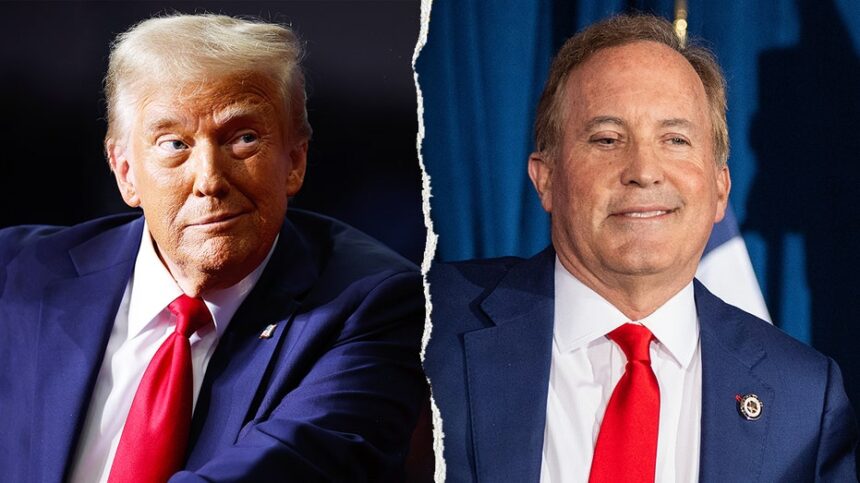
Texas Attorney General Ken Paxton is the Republican nominee for the U.S. Senate seat currently held by Sen. John Cornyn after Paxton handily won the runoff against Cornyn on Tuesday. When President endorsed Paxton late in the race, the campaign was effectively over. It is President Trumps GOP, and his endorsement in a primary is the decider. Period.
Had Cornyn been the nominee, his re-election would have been a layup. Paxtons race against Texas state Rep. James Talarico will be much more like a contested 3-pointer in the NBA than a layup. Talarico is indeed, as President Trump nicely summed it up, “weird.” But even given that, Paxton will need to raise a ton of money because the engines of the Democratic fundraising machine are already at top speed for the hard-left Talarico. Paxton should win, but even Golden State Warriors star and future NBA Hall of Famer Steph Curry hits only slightly more than 42% of his shots from beyond the arc. Curry may be the best ever, but its a tough task to drill that shot.
So too is Paxtons task. The entire Texas GOP will need to get behind him quickly, and Paxton will need Cornyns half-million runoff voters and his financial supporters. The whole GOP will need to swing behind Paxton, even though Cornyn is respected and admired by longtime conservatives like me who value his knowledge of the Constitution, his work on the Judiciary Committee in every tough fight there over decades, and his tenure as GOP whip. But party loyalists have to know that ours is a two-party system and Winston Churchills admonition, “Trust the people!” applies in every fair contest.
So too does the wisdom of another brilliant prime minister of Great Britain â Benjamin Disraeli, whose years as leader of the s Conservatives came in the 19th century.
“It is not becoming in any Minister to decry party who has risen by party,” Disraeli declared long ago. “We should always remember that if we were not partisans, we should not be Ministers.” The same applies to every elected member of the GOP Senate stung by the defeat dealt their friend by the Lone Star States Republican voters.
The Senate majority is very much up for grabs in the fall. must defend four seats in which Democrats will mount well-financed campaigns, even if their nominees are weak. Sens. Susan Collins of Maine and Jon Husted of Ohio face hard-left Democrats in Graham Platner and former Sen. Sherrod Brown. Platner is quickly becoming an albatross for Democrats across the country, as well as in Maine, but Maine is a purple-to-blue state. Brown is as formidable a candidate as Democrats can field in ruby-red Ohio.
Republicans also have to defend an open seat in . Former national GOP chairman Michael Whatley has considerable skills and financial backing, but he drew the best candidate of all the Democrats in 2026s close races: former Tar Heel State Gov. Roy Cooper. Democrats have a vulnerable incumbent in Georgia, where Sen. Jon Ossoff is still very much the “accidental senator,” but he is as hard-left as Democratic activists and donors want. Michigan, Minnesota and New Hampshire are all seats held by retiring Democrats, and Republicans should nominate excellent candidates not just against Ossoff but also in these three states.
So while the GOPs current margin in the Senate is three, and control would flip to Democrats only if their nominees win four of the seven seats “in play,” thats not an impossible result, especially in the sixth year of any presidency.
The actual accomplishments of all presidents eventually get reduced to two or three lines in American textbooks. TR, for example, is best known for the Great White Fleet, the national park system â and the election of Woodrow Wilson and all the ill that was brought down upon the country because of Roosevelts decision to split the GOP in 1912. Richard Nixons three are summed up as opening , détente with the Soviets and Watergate. It pretty much works that wa