


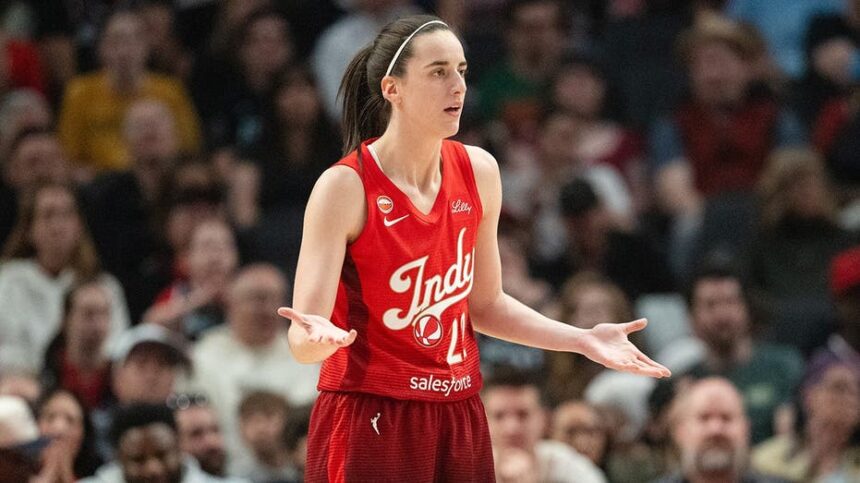
USA Today columnist Nancy Armour wants Caitlin Clark to stop flopping and berating WNBA officials.
Plenty of people agree with that take, including OutKick’s Dan Dakich.
Others would argue that Clarks frustration is understandable, given the physical treatment she has received and the WNBAs inconsistent officiating. Either way, Armour is well within her rights to criticize Clarks behavior on the court.
But Armours latest column goes much further than that. Much, much further.
Armour argues that Clarks reactions to missed calls put “Black” and “queer” WNBA players “in danger,” essentially blaming Clark for sent by people she doesnt know and has publicly condemned.
No, this is not satire.
SPORTS MEDIA HAS CREATED AN INDUSTRY OUT OF COMPLAINING ABOUT WHITE ATHLETES LIKE CAITLIN CLARK
The column begins by declaring that Clark and her “enablers must take the rest of us for idiots.” Armour points to two recent plays, one involving Chelsea Gray and another involving Kiah Stokes, as proof that Clark exaggerates contact and creates false narratives about opposing players.
As far as the Gray play, Armour and others have pointed out that Clark didn’t go to the floor until after the whistle, suggesting that she was pretending to be hurt.
But anyone who understands sports beyond using them as a vehicle for political commentary knows that athletes routinely play through pain while the action is still live, then react once the whistle blows. Clark waiting until the play ended before going down doesn’t prove that she faked an injury.
The second play shows that this column isn’t really about whether Clark flops. Armour is using disputed basketball plays to push a left-wing narrative about “Black and queer” women in the WNBA.
During Indianas July 15 loss to Golden State, Clark drove to the basket and Stokes collided with her. Clark made the layup, fell to the floor and got up limping. She then charged toward an official to complain about the no-call before briefly going to the locker room.
Clark later said and that she played the remainder of the game with a contusion.
Armour puts “contusion” in quotation marks and says the replay showed minimal contact.
The slow-motion video shows Stokes knee hitting Clark in the exact area Clark identified. While the contact didn’t appear to be malicious, like some of the contact Clark has endured during her WNBA career, it still clearly happened.
That doesn’t necessarily mean officials missed a foul. Clark initiated some of the contact while driving to the basket, and reasonable people can disagree about whether the play deserved a whistle. Personally, I thought the contact was incidental and didn’t deserve a foul call.
But there is a major difference between arguing that the contact was not a foul and suggesting Clark fabricated or exaggerated the injury.
Armour didn’t examine Clark. She’s certainly not a doctor or a trainer. She watched a replay and decided that Clark couldn’t have suffered a contusion.
That’s quite a medical diagnosis from someone with no medical training who never evaluated the patient.
It also weakens the entire premise of Armours column. Her argument depends on Clark falsely portraying “Black” and “queer” opponents as aggressors. Yet neither example she cites proves anything.
After the Fevers victory over Las Vegas, Gray shared a direct message in wh





